
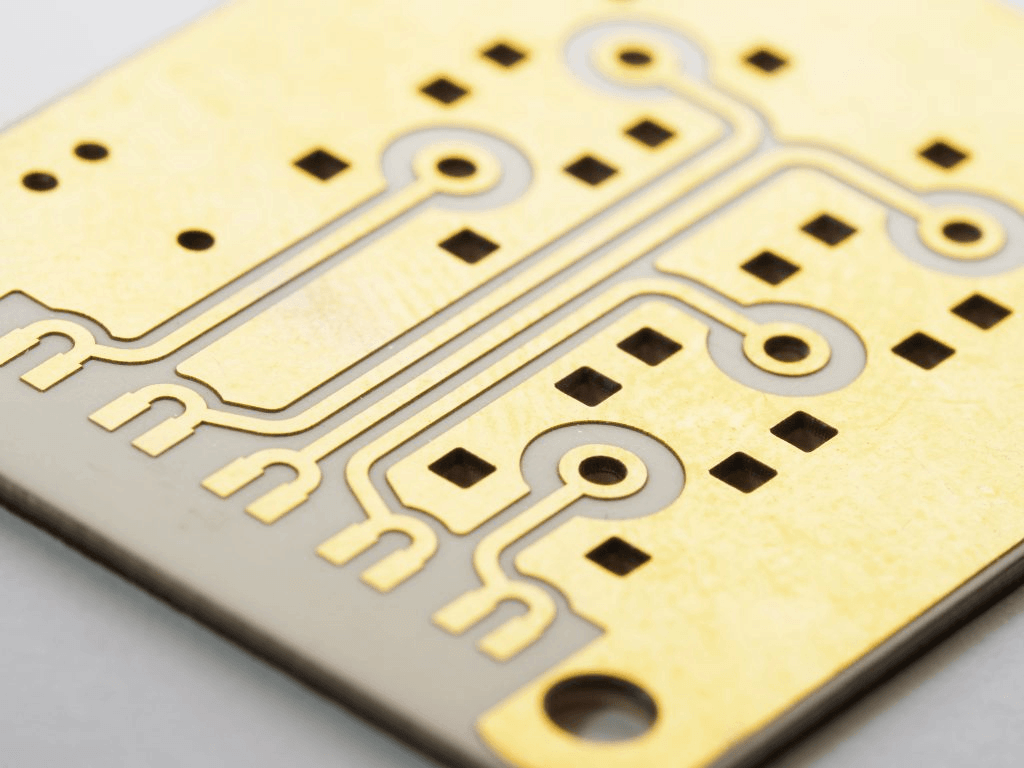
What Makes a Multilayer Ceramic PCB Worth Specifying?
We must understand the specific functions of ceramic materials, their key applications, and the scenarios in which multilayer ceramic PCB are applicable. Not all designs require ceramic materials, but for those that do, switching from FR4 substrates to ceramic substrates is not advisable. This is to ensure the circuit board’s durability in practical applications. The challenge most engineers and procurement teams face is whether this performance gap justifies the cost and lead time benefits for specific applications.
How Ceramic Changes Performance
Aluminum oxide (Al₂O₃) substrates deliver thermal conductivity of 20–30 W/m·K — roughly 70 to 100 times higher than FR4. Aluminum nitride (AlN) pushes further still, reaching 150–180 W/m·K for applications where heat flux density is extreme. Either substrate removes the thermal ceiling that limits FR4-based designs.
Dielectric constant stability is the other major shift. Ceramic substrates hold their Dk value from -55°C to well above 300°C, across the full frequency range relevant to modern RF and high-speed digital applications. Signal integrity stays predictable. Impedance holds where the design placed it. There’s no frequency-dependent correction factor to engineer around.
Alumina’s expansion coefficient of 6–7 ppm/°C is close to silicon and GaAs, reducing thermal cycling stress on die-attach interfaces. For designs intended for 10+ years of operation without maintenance, this difference leads to significantly lower failure rates over the product lifecycle.
Building these properties into a multilayer ceramic PCB stack-up adds routing density and EMI containment without compromising thermal or electrical advantages. This combination of multilayer flexibility on a ceramic base makes the format worth the complexity for the right application.

Key Considerations for Ceramic PCB Material Selection and Manufacturing
Thermal Conductivity by Material: Material choice in ceramic PCB isn’t one-size-fits-all. Al₂O₃ at 96% purity and 99.6% purity have different thermal conductivity values, which are critical for thermal models but often not reflected in generic quotes. For power electronics exceeding 200W per module, AlN is preferred when alumina’s conductivity is insufficient. Always request material certification that traces back to the raw substrate supplier, as the grade affects thermal performance.
Layer Count & Stack-Up Options: Ceramic PCBs can be produced in 2-layer to 24-layer configurations. The selection is based on signal routing, power distribution, and grounding needs, similar to FR4 boards. However, ceramic lamination constraints affect the design and bonding. Mixed-material builds, such as ceramic sub-assemblies laminated into FR4, are ideal for designs requiring targeted thermal performance while keeping standard manufacturing processes.
Surface Finish Requirements: ENIG (Electroless Nickel Immersion Gold) is the standard for ceramic PCBs, providing a nickel base and a gold layer to prevent oxidation. For wire bonding or long storage, NiPdAu is an alternative. Gold finger processing is available for edge connectors. Specify surface finish with thickness tolerances, as they are more critical on ceramic substrates than on FR4. Thinner gold layers can cause solderability issues during assembly.
Ceramic in Multilayer Ceramic PCB Design
NVMe PCIe Gen 4 operates at 16 GT/s. Gen 5 doubles that to 32 GT/s. At those data rates, the substrate is not just a passive carrier. It becomes a signal integrity variable that must be controlled precisely. Differential impedance at 85Ω for PCIe lanes, Dk tolerance across the stack-up, and via structures to avoid reflections — these must be backed by data, not estimates, from a multilayer SSD PCB supplier.
Ceramics’ direct role in SSD design sits primarily at the controller and power conditioning level. NAND flash controllers running sustained workloads generate thermal density that FR4 carrier boards handle marginally at best. Ceramic-substrate power sub-assemblies bring that thermal load under control — lower junction temperatures, more stable voltage regulation, and lower field failure rates on high-performance storage products.
For procurement teams sourcing a multilayer SSD PCB board supplier at Gen 4 or Gen 5 speeds: controlled impedance reports, material Dk certification, and documented via modeling should be standard deliverables, not optional requests.

Who Uses Ceramic PCB and Why
Automotive is the largest application segment. ADAS processing boards, engine control units, and EV power electronics combine the temperature range, vibration load, and signal frequency demands that make ceramic the substrate of choice — and FR4 the substrate of compromise.
Telecommunications infrastructure relies on ceramics’ stable dielectric for 5G small cell hardware, microwave backhaul, and optical module substrates. Hardware installed in the field and expected to operate for years without retuning needs a substrate whose electrical properties don’t drift.
Industrial power electronics — particularly high-voltage isolation boards rated at 3,000–4,000V across the substrate — requires dielectric strength and thermal performance that ceramic provides cleanly, and FR4 reaches only at significant derating.
Optical modules at 400G and 800G speeds sit at the intersection of high frequency and high thermal density. Ceramic handles both simultaneously; no polymer laminate alternative does so as cleanly at production volumes.
Key Factors to Evaluate When Choosing a PCB Supplier
The ceramic PCB market is niche, and industry standards vary. While manufacturing capabilities differ, material procurement is the most crucial factor. A top-tier supplier is defined by its yield rates and reliability, not just the initial quote. Here are four key points to verify before selecting a supplier:
- Process Records: Request lamination history and yield data for similar designs.
- Material Traceability: Ensure certifications trace back to the raw material supplier, including purity and thermal conductivity.
- Surface Treatment Thickness: Ask for reports on ENIG layer thickness from past batches, ensuring precise plating control.
- Certifications: Check for ISO 9001 and, for automotive applications, IATF 16949 compliance or equivalent process controls.
A reliable supplier will provide clear, data-backed answers. If not, it may indicate issues with their process.
