
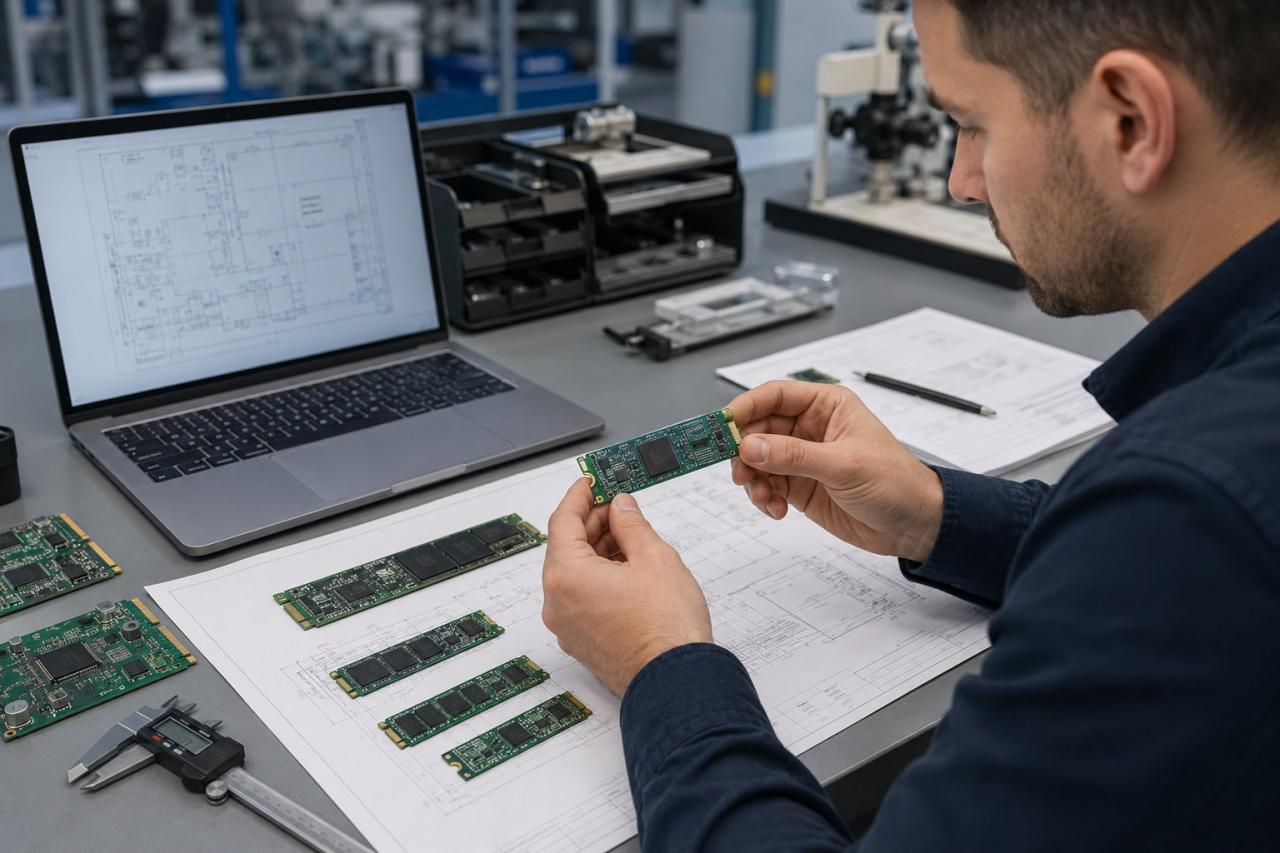
5 Questions to Ask Your Custom SSD PCB Manufacturer
Getting a quote back fast feels good. But fast quotes don’t tell you whether the manufacturer in front of you can actually deliver what your design needs. The wrong custom SSD PCB manufacturer doesn’t just slow down your project — it can compromise signal integrity, push back your product launch, and cost far more to fix than to prevent. These five questions cut through the sales pitch and get to what actually matters.
Question 1: What Are Your Layer Count and Trace Capabilities for Custom SSD PCB Production?
This is where capability gaps show up fastest. A manufacturer may advertise multi-layer PCB production, but lack the precision processes required for high-speed SSD applications. Before committing, ask for the exact specifications: minimum trace width, minimum trace spacing, minimum hole diameter, and the layer range they routinely produce — not just theoretically support.
For NVMe and M.2 SSD PCBs, the bar is high. Industry benchmarks for high-speed SSD boards typically require trace widths at 3/3 mil or finer, hole diameters as small as 0.15 mm, and layer counts of 8 to 10 layers or more to manage impedance and signal integrity. If a supplier hesitates on these numbers or can only speak in general terms, that’s a red flag worth taking seriously.

Question 2: Can You Show Production Cases for Custom SSD PCBs Similar to My Design?
Spec sheets are easy to produce. Real case studies are not. Ask your custom SSD PCB manufacturer to walk you through a completed project that’s comparable to yours — same interface type, similar layer count, equivalent surface treatment requirements.
A credible supplier should be able to show you board dimensions, material choices like FR4 TG170, surface treatment options such as Immersion Gold at 2u’, and the solder mask specifications used in actual production. If they can’t point to at least one relevant example, your order may be their learning experience — not a good position to be in when your design has tight tolerances and a real deadline.
Question 3: What Quality Control Standards Does Your Custom SSD PCB Process Follow?
Quality control in PCB manufacturing isn’t a single checkpoint at the end of the line. It’s embedded across every stage — from raw material selection through drilling, plating, imaging, and final inspection. Ask specifically: which international standards do they certify to, and how is quality verified at each stage?
Look for ISO 9001 certification as a baseline. For SSD PCBs destined for industrial or automotive applications, UL certification matters too. On the production floor, AVI (Automated Visual Inspection) lines and electrical testing should be standard practice, not optional add-ons. Manufacturers who follow IPC standards bring an additional layer of industry-recognized process discipline to their production environment. If the answer to your quality question is vague, the process probably is too.
Question 4: What Lead Times and Order Quantities Apply to Custom SSD PCB Orders?
Lead time and MOQ mismatches are among the most common reasons B2B sourcing relationships break down before they start. A manufacturer optimized only for mass production may quote MOQs that are impractical for prototype runs or early-stage product development. Conversely, a supplier focused entirely on small batches may struggle when your volume scales.
Ask for both: the lead time for prototype or sample quantities, and the lead time for volume orders. Quick-turn options typically run 5 to 7 business days for standard builds; volume production lead times vary by complexity but commonly fall in the 15 to 25 business day range. Make sure both ends of that spectrum are covered before you sign anything.

Question 5: Does your company’s customisation process include a DFM review?
Design for Manufacturability( DF) is the step that prevents expensive surprises. A thorough DFM review catches issues in your Gerber files before production starts: trace spacing violations, pad size inconsistencies, via placement problems, or impedance mismatches that would compromise signal performance on a finished NVMe board.
Ask whether a DFM review is part of the standard quoting process or something you need to request specifically. The best custom SSD PCB manufacturers treat DFM as a built-in engineering service, not an extra paid service. It’s also a reliable indicator of technical depth — suppliers who invest in pre-production review are typically the same ones who invest in production quality. A good SSD PCB supplier will flag DFM issues proactively, not wait for you to discover them after delivery.
Choosing the Right Custom SSD PCB Manufacturer Starts with the Right Questions
Five questions. That’s the difference between a supplier who sounds capable and one who demonstrably is. Capability specs, real case examples, certified quality processes, realistic lead times, and a DFM-first approach — these aren’t nice-to-haves. They’re the minimum standard for any custom SSD PCB manufacturer worth building a sourcing relationship with. Ask these questions up front, compare the answers carefully, and you’ll avoid the costly mistakes most buyers only learn about after the first order goes wrong.
