
How to Procure HDI Multilayer PCB for Avionics Systems?
Avionics procurement leaves no room for error. When a flight management system or navigation controller fails, the consequences go far beyond a simple warranty claim. That’s why sourcing HDI multilayer PCBs for avionics projects involves much more than comparing prices on a spreadsheet.
Next, we’ll walk you through everything from supplier capabilities and technical specifications to certifications, pricing, lead times, and procurement risks—because every decision can impact product reliability and program timelines. Here’s what buyers need to evaluate before placing an order.
Identify Suppliers That Can Actually Handle HDI PCB Requirements
Most manufacturers will take your RFQ. Far fewer can deliver a board that survives in an avionics environment. The gap between those two groups is where procurement mistakes happen — and where programs get delayed.
Start by requesting documented references for avionics projects. A supplier with a genuine track record in HDI multilayer PCB production for flight control or navigation systems operates with a different level of process discipline than one that occasionally accepts aerospace orders. If they can’t name programs or customers, that’s your answer.
From there, confirm that their HDI PCB manufacturing setup includes laser drilling, sequential lamination, in-house AOI, and X-ray inspection. DFM review should be a standard part of their process — not an upsell. A supplier that only reacts to your Gerber files will create rework cycles you don’t have time for. Also, ask about backup production capacity. A single-facility operation with no contingency is a supply chain risk on any program with fixed integration milestones.
Confirm Critical Technical Specifications Before Ordering HDI Multilayer PCB
Specification misalignment between procurement and engineering is one of the most common causes of program delays. For HDI multilayer PCB orders in avionics, the earlier you lock down specs with your supplier, the less time you’ll spend on back-and-forth after production begins.
Get your engineering team to sign off on the full specification package before issuing any purchase order. That means layer count, via structure, impedance requirements, surface finish, and material callouts — all confirmed and documented. Verbal agreements on HDI PCB specs don’t survive supplier handoffs.
Layer Count and Via Structures
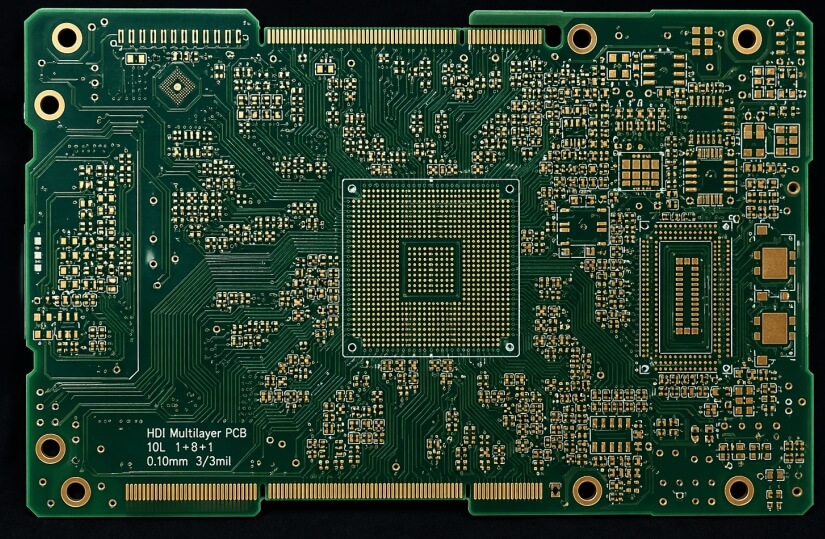
Avionics HDI boards typically run 10–20+ layers with sequential build-up structures such as 2+N+2 or 4+N+4. Confirm the supplier supports stacked and staggered microvias (≤0.15mm laser-drilled). Not every manufacturer that claims HDI capability can actually execute these structures — ask for a cross-section sample or test coupon data.
Impedance Control and Material Requirements
Signal integrity on avionics data buses — MIL-STD-1553, ARINC 429 — requires impedance tolerances of ±5% or better, verified by TDR coupons on production panels. Modeling alone isn’t sufficient. For materials, standard FR4 degrades above 130°C. Specify high-Tg FR4 (Tg ≥ 170°C) at minimum; evaluate Rogers or polyimide laminates for RF-intensive sections. Confirm that the supplier stocks these materials — last-minute sourcing is a common lead-time killer.
Certifications Your HDI Multilayer PCB Supplier Must Hold
In avionics, certifications are the documented proof that a supplier’s process is auditable and under control. Missing the right ones can invalidate your own product qualification — a problem that surfaces at the worst possible moment.
The two non-negotiables are AS9100D and IPC-6012ES. AS9100D covers aerospace-specific quality management, including risk control, configuration management, and FOD prevention — requirements that go well beyond ISO 9001. IPC-6012ES sets the performance and qualification requirements for rigid avionics PCBs, with tighter plating tolerances and stricter thermal cycling criteria than those of standard IPC Class 3. Verify AS9100D certificates through the IAQG OASIS database — not through a PDF that the supplier emails you.
Product Testing Documentation and Traceability
Every shipment should include a full documentation package: Certificate of Conformance, material traceability records, impedance test coupons, and AOI/X-ray inspection reports. Ask for a sample documentation package before placing your first order — suppliers who hesitate to share one are typically the ones who assemble it retroactively.
Traceability requirements vary by program. Some require serialization to the individual board level; others accept lot-level traceability. Clarify this with engineering before procurement begins, then confirm the supplier can meet it.
Understand What Affects HDI PCB Pricing
Avionics HDI multilayer PCBs cost significantly more than commercial boards, so understanding key cost drivers is essential. Layer count heavily impacts pricing—moving from 12 to 16 layers can raise costs by 30–50%. High-Tg FR4 and Rogers materials also increase costs, while testing requirements such as AOI, X-ray, and IPC Class 3 inspections add to expenses. Prototype units are typically far more expensive than units produced at volume, so plan budgets accordingly.
Plan Lead Times and Delivery Schedules
Avionics schedules are tight, and unrealistic lead time assumptions often cause delays. Prototype HDI PCBs typically require 15–25 working days, while complex stacked microvia designs may take 25–35 days. Mass production usually takes 4–8 weeks. Build in at least a two-week buffer and confirm expedited options in advance.
Common HDI PCB Procurement Risks to Avoid
Choosing based only on price. Total cost of ownership — not unit price — is the right metric. HDI PCB failure in avionics means redesign, requalification, and schedule slip that dwarfs any savings from low-cost sourcing.
Incomplete certifications. ISO 9001 alone does not qualify a supplier for avionics HDI multilayer PCB production. AS9100D and IPC-6012ES are mandatory. Don’t accept substitutes.
Poor delivery performance. Ask for on-time delivery data specifically for avionics programs — not aggregate performance across all product types. The two numbers are often very different.
Material substitution. Include explicit no-substitution clauses in purchase orders and require advance notification of any material change before production begins, not after.

Final Procurement Checklist for Avionics HDI Multilayer PCBs
- Supplier verified — AS9100D and IPC-6012ES confirmed via issuing body; avionics references reviewed; in-house X-ray confirmed
- Specs confirmed — Layer count, via structure, impedance tolerance, and material callouts signed off by engineering
- Certifications reviewed — CoC format, traceability records, and test documentation package reviewed and accepted
- Pricing approved — Itemized quote reviewed; prototype vs. volume pricing understood
- Delivery timeline confirmed — Lead times verified; buffer built into integration schedule; expedite terms documented
