
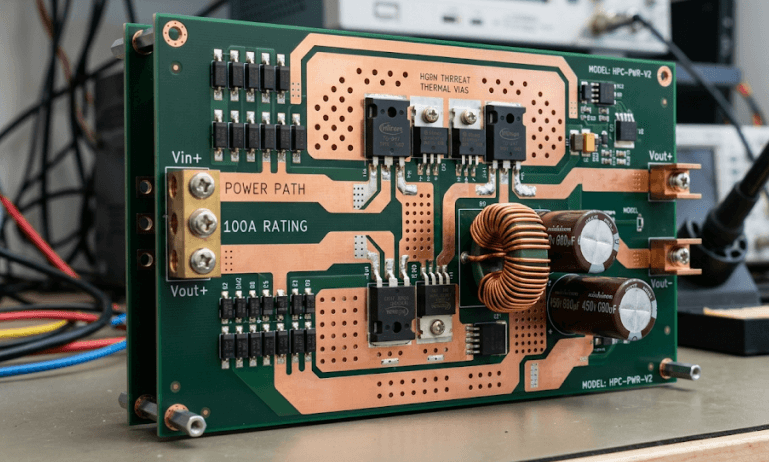
What Is a Heavy Copper Power PCB and When Do You Need One
Standard PCBs have a current ceiling. Push past it and traces overheat, vias crack, and the board fails, not because the design was wrong, but because the material wasn’t built for the job. A heavy copper power PCB is what you use when the ceiling isn’t high enough. The copper weight on these boards runs from 2oz all the way to 20oz. Standard boards use 1oz. That gap is the whole story.
Heavy Copper Power PCB Definition, Standards, and Core Principles
“Heavy copper” has a specific meaning. It’s not a loose descriptor. It’s a defined set of physical parameters that change how a board performs under load.
What Defines a Heavy Copper Power PCB?
Copper thickness is what separates a heavy copper power PCB from everything else. Standard boards run at 1oz, about 35µm. Heavy copper starts at 2oz and goes up to 20oz, with 3oz and 6oz being the most common for power applications. A 6-oz layer measures roughly 210µm, six times the copper cross-section of a standard board. That extra thickness does three things: it lowers trace resistance, increases current capacity, and improves heat distribution across the board. Standard boards carry milliamps to a few amps. A heavy copper PCB carries tens or hundreds of amps continuously, without degrading.
Copper Weight and Its Role in Performance
More copper means lower resistance. Lower resistance means less I²R heating for the same current load. The board runs cooler, and cooler means longer service life. Via walls tell the same story. Every thermal cycle, heating and cooling down, puts mechanical stress on the board. Standard via walls thin and crack over thousands of cycles. Heavy copper via the walls holds. In industrial or automotive environments where a board cycles hard for years, that difference is the difference between a reliable product and a field failure.
How Heavy Copper Power PCB Manages Heat and Load?
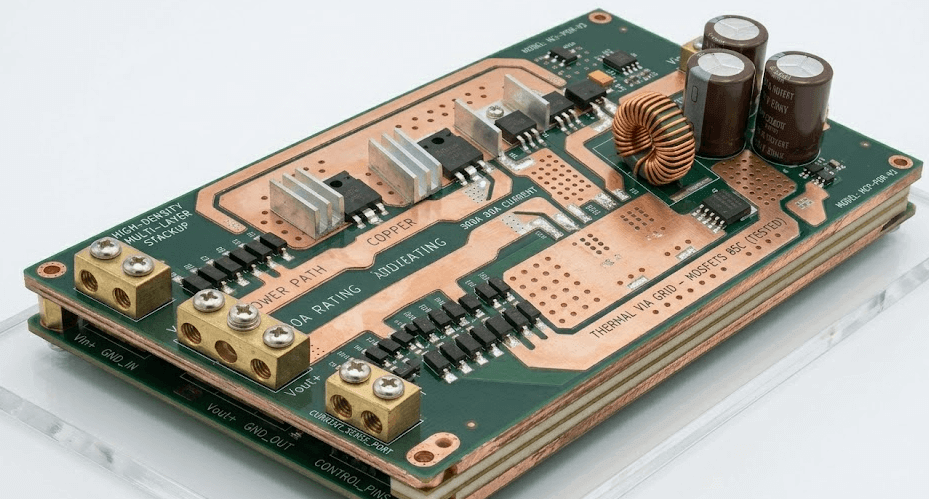
Copper weight, via structure, and surface finish each affect both current handling and thermal behavior. A well-designed heavy copper power PCB treats these as one problem.
Current Capacity and Copper Thickness
Copper thickness sets the current ceiling before trace width even enters the equation. Planar transformer boards are a clear example of high continuous current, tight copper windings, and a demanding thermal environment. These designs use 4oz copper, stack up to 14 layers, and run at board thicknesses of 3.0mm or 6.0mm. Those numbers come directly from what the current density requires.
Thermal Management in Heavy Copper Power PCB
Thick copper spreads heat laterally. Thermal vias move it vertically, from hot component layers down to copper planes or heatsinks. Via sizing, placement density, and plating quality all determine how efficiently that transfer happens.
ENIG surface finish gives a flat, oxidation-resistant surface that holds up through high-temperature assembly and long storage. HASL costs less and solder well, but its uneven surface profile can cause issues on thick copper features or fine-pitch pads. The right choice depends on the assembly process and end-use environment.
Real-World Applications of Heavy Copper Power PCB
Industrial power systems, VFDs, motor controllers, and UPS equipment run continuously and generate heat with every switching cycle. 3oz to 6oz copper with reinforced via structures is what keeps these boards alive through years of thermal cycling.
Automotive electronics, onboard chargers, battery management systems, and inverter modules add vibration and wide temperature swings on top of the current challenge. Heavy copper multilayer construction handles all of it together.
Renewable energy inverters carry a 20-year service life expectation. Lower operating temperatures from heavy copper construction are what make that timeline achievable.
In each case, a standard board isn’t a marginal choice. It’s the wrong one. A heavy copper power PCB is what makes long-term reliability possible.
Key Considerations When Ordering a Custom Heavy Copper Power PCB
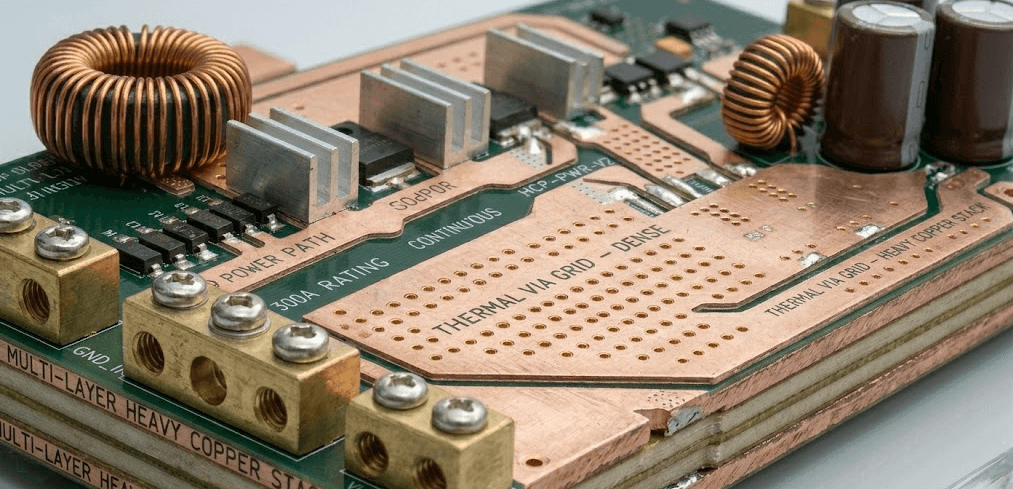
Design requirements first. Current load, voltage, and thermal targets set the minimum copper weight. Trace width, via sizing, and stackup all follow from those numbers, not the other way around.
Manufacturing capability matters more than price. Consistent copper weight tolerance at 3oz to 6oz, validated ENIG and HASL surface finishes, and multilayer capability up to 14 layers; these are the process benchmarks that separate capable manufacturers from those who treat heavy copper as a standard job with thicker foil.
Certifications are a process of evidence. IATF 16949:2016, ISO 9001:2015, and UL mean plating depth, etching control, and via integrity are verified through structured procedures. For automotive or industrial power boards, that’s a baseline requirement.
A cheaper board that fails in the field costs more than a correctly specified one that doesn’t. Total cost of ownership, not unit price, is the right metric for heavy copper procurement.
Why Heavy Copper Power PCB Meet Your Needs?
High current, high heat, long service life: these are the conditions where a heavy copper power PCB stops being an option and becomes the only sensible specification. The current capacity, thermal performance, and structural durability aren’t achievable with standard construction. The right copper weight, the right thermal design, the right manufacturing process, those three things together are what a well-specified custom heavy copper PCB board delivers. And in environments where failure isn’t acceptable, that’s exactly what the application needs.
